Tony Award Winning Clybourne Park Sparks Conversation about Race
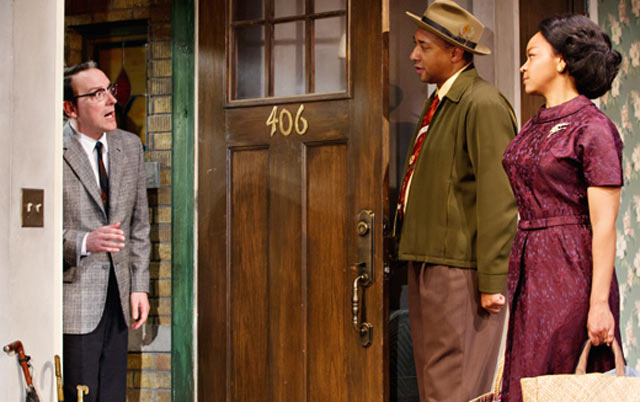
(Photo credit: Colorlines.com http://colorlines.com/archives/2012/06/how_to_talk_about_race_without_getting_stuck_in_clybourne_park.html)
The 2012 Tony Award Winner for Best Play, Clybourne Park, illuminates the undeniable influence that race and racism has had, and continues to have, on the U.S. housing market.
ERASE Racism organized a May 6th theatre outing to see the play, which is currently showing at the Walter Kerr Theatre, followed by a group discussion.
The first act of the play takes place in an all-white neighborhood in Chicago in 1959. Influenced by Lorraine Hansberry’s “A Raisin in the Sun”, writer and director, Bruce Norris tells the story of the white family that sold their house to a black family and the community resistance that followed.
The same Karl Lindner from “A Raisin in the Sun” tries to persuade the house’s white owners not to sell to a black family out of fear of plummeting property values and a “changing” neighborhood culture. In an interview with the NY Times, Norris said that after reading Hansberry’s play as a child he realized “that we, the all-white students of my school, were the offspring of Karl Lindner.” “That’s a lesson that sticks with you, the lesson that you are, essentially the villain in someone else’s story,” he said. “Many years later I thought, what if we turned the story around and told it from the opposite angle, the angle of people like my family, the villains, the ones who wanted to keep them out?”
The second act of the play, which takes place in the same house 50 years later, brings the connection of race and housing to the current day. This time a white family is trying to buy the house in a majority black neighborhood that is undergoing gentrification—the changes, such as rising home prices, that result when wealthier people acquire or rent property in low income and working class communities. While the conflict does not begin as overtly racial as the one 50 years prior, Norris leaves the audience with an undeniable feeling that not much progress has been made.
Tiffany Bradley of Colorlines.com says of the play, “The talk of race sucks the air out of the room, exposing prejudice and insecurity underneath the studied colorblindness of the couples. Everyone ends up a victim; everyone ends up attacked. It’s easy to walk away from the performance skeptical about productive conversation between people of different racial and ethnic backgrounds.”
Although difficult, revealing forms of structural racism and discrimination in a way that can create meaningful dialogue about race can be done. Through ERASE Racism’s work on Long Island over the past eleven years, we have seen the overwhelming denial of racism in the region slowly replaced by recognition of the problem. This leads to a commitment by some to work to create racial equity. While many would like to think that America is post-racial, we know that the Karl Lindners of today still exist. Much work remains to be done.
We encourage you to see Clybourne Park and use it as a tool to spark constructive conversations about structural racism and actions that can be done to create change.
Here is what some of our partners had to say after watching the play.
“This is a play that operates on several levels. Because it is funny, I am sure it has wider commercial appeal than Raisin in the Sun. Lorraine Hansberry’s play was obviously the inspiration for the play and the first and second acts take the form of a prequel and a sequel to Raisin.
“I believe the opportunity we had to discuss the play afterwards and the different perspectives offered by the participants allowed us to surface issues that were referenced with only a few lines in the play. The discussion of race in the second act might be indecipherable for members of a lay public. The dialogue and the passionate statements by the characters in the play were short hand for very complicated political and cultural conflicts.
“In our own group I heard discussion of the obstacles that we impose on our own success and the need to face or confront those, the difficulty of parsing the language, meaning and relationship of various forms of subordination and privilege, and the ease with which a challenge to the class and racial privilege can be “reframed” as reverse racism.
“The play raised the issues. I believe the discussion we had after the play gave us all an opportunity to explore these ideas in depth. Thank you so much for this opportunity for reflection and fellowship.”
-Deborah Waire Post
“Yesterday's event combining theater, discussion and dinner was a unique experience for me. I generally go to the theater alone or with one friend; the process of integrating what I see into my life experience is almost always cerebral and insular. The opportunity to share insights, ideas, concerns and questions with a group whose diversity I value and whose opinions I hold in high regard was extraordinary, and the immediacy made it even more so. “
- Suzy Sonenberg
“Bruce Norris' play, Clybourne Park, surprised me with its honesty about the issues of Real Estate and Racism.
With authenticity and compassion, the characters in Clybourne Park play out the dramas (and traumas) faced by black, white and indeterminate-color families having to do with where they live and what kind of neighbors they will seek (or be to others.)
Participants in ERASE Racism's theater party discussion had a "field day" probing the complexities of the play.
I felt a sense of relief that the play's explicit treatment of the issues gave me license to speak freely about the complicit elements of racism. “
-Amy Hagedorn
“I loved the camaraderie offered through this event so I am hoping that this is a start and that I will be included in the next outing. As I shared in our discussion I was deeply disturbed by the second act and that was influenced by the hope that I felt when I left A Raisin in the Sun. In the second act I felt despair the minute the sets appeared and wondered if it left folks with the thoughts of “see what happens when we let them in the neighborhood”? It was a stark reminder to me that we are still driven by the same fears and small mindedness that racism breathes. We have become more politically correct in our language but the insidiousness of racism has travelled through the last 50 years and has landed safely in full form in the present day.”
-Lorna Lewis
“The sun shined so brightly as we gathered outside the theater; the brilliant moon accompanied us on our journey home. The subject of the play captured each of our passions, and it was a joyous sharing among old and new friends.
“The one thought I do have is ....So much has changed!!! So little has changed!!!”
-Miriam K. Deitsch
“Thoughts evolved as we shared Clybourne Park. I think the audience "got" the second act. Sure, modern life is complex and requires the ability and will to sort through many issues of privilege, race, class, culture and gender. There's lots of work to do in developing that will and ability to change our perspectives. That's why Clybourne Park and ERASE's work is important. I hope to join some of you in the Unraveling Racism workshop.”
-Sue Hagedorn