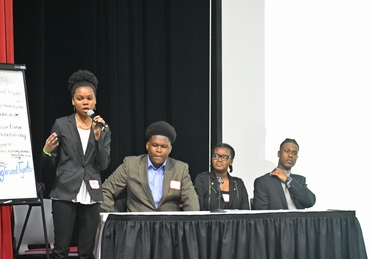
 On March 10th, at Molloy College, Wesley Jean-Pierre, a senior at Amityville High School recounts a post-basketball game incident at his school. Students at his predominantly African American school were rightfully enraged after students from a predominately white school called them racial slurs. Wesley waited for one of the adults at his school to say something or do something in response to the incident but there was silence. Voicing his disappointment over the lack of communication between students and staff about racism he said, "For all the adults in this room, we all matter, we all matter in this subject [racial equity]."
The Linking Knowledge to Action Education Forum sought to educate those present about the inequities in Long Island Schools and facilitate a dialogue amongst and between students and adults about problems and remedies. The concern is not just silence in the face of racist incidents. A variety of issues were brought forward by the four student panelists at the forum.
Jahnia Cunningham, a 10th grader at Elmont Memorial High School reminded adults that, “Inequality isn’t right. I want adults to know that they [should] teach the younger generation what they need to know [and how] . . . to reform society”. A poem she wrote was read, which was a winner of the ERASE Racism sponsored essay contest which asked Long Island students to respond to the 2017 Charlottesville incident with a poem, video, or op-ed.
Daniel Foster, a senior at George W. Hewlett High School, commented on his positive experience at ERASE Racism’s full-day Student Voices Campaign: Long Island Leaders of Tomorrow conference, where 70 students from 16 different districts came together to discuss the role of racism in the development of Long Island and student leadership. He also discussed ways that he and educators at his school collaboratively promoted diversity. One way in which they did this was by hosting a World Café discussion on food, LGBTQ, and race equity. He also talked about a radio show that he hosts that explores race.
Gabrielle Barnes, another senior from George W. Hewlett High School commented about her excitement of meeting a diverse group of like-minded students at the Student Voices: Long Island leaders of Tomorrow Conference. She also expressed how living in diverse places such as Trinidad and Tobago, Florida, and New York has helped shape her view of the world and instilled her appreciation of diversity.
All of the students on the panel expressed a hope that moving forward the educators and the students will take on the tough conversations and that students will feel more comfortable voicing their concerns.
The forum was organized by ERASE Racism, The Links, Long Island (NY) Chapter, and Molloy College’s Education Leadership for Diverse Learning Ed.D. Program. This was the beginning of an interesting collaboration of a social justice organization focused on equity and the dismantlement of structural racism, a volunteer women’s organization in service to African Americans and other persons of African Ancestry with a diverse membership, including many educators, and a doctoral educational leadership program dedicated to preparing highly qualified educators who will advocate for programs and policies for diverse learners.
After opening remarks by Leah E. Watson, President of the Long Island (NY) Chapter of The Links, Incorporated and Andrea Honigsfeld,Ed.D. , Associate Dean and Director of the Doctoral Program in Education at Molloy College, Elaine Gross, ERASE Racism’s president presented its Education Equity Infographic of a recent ERASE Racism report, A Decade of Change: Growing Segregation on Long Island. The number of black and Latinx students attending intensely segregated public schools on Long Island has tripled from 12 years ago. The overwhelming majority of black and Latinx students attend low-performing schools with high concentrations of poverty, leaving them with few opportunities to benefit from an array of high-performing Long Island schools due to school segregation. Moreover, research shows that all students can benefit from racially and ethnically diverse schools. Integrated learning environments help to dismantle racial stereotypes and better prepare students to be successful in increasingly diverse workplaces and communities.
The Linking Knowledge to Action Education Forum gave students a platform to voice their concerns, perspectives, and insights to the adult forum participants, an opportunity seldom made available to our youth. It explored the current state of racial and economic segregation in Long Island Public schools and the resulting inequities in education by facilitating student-led panels, brainstorming workshops, and open dialogue.
Gabrielle led a student-centered brainstorming session about the challenges students face and the ways they could implement changes. One issue that came up was the importance of hiring staff that are comparable to the demographics of the student body. Students expressed that student and teacher diversity was crucial to public school education equity. Another topic was the importance of curriculum that present and embrace a wide variety of cultural perspectives and expertise. Students also agreed that multicultural festivals promoted diversity in a positive way and allowed them to experience cultures in a fun, engaging manner. One of the biggest takeaways from the brainstorming session was that students wanted more time to discuss issues with their teachers. They suggested creating clubs or monthly meetings that allow students and teachers to discuss a wide variety of issues.
They later presented their findings during the Wrap-Up presentations. “I encourage you guys to be an example to others. If we change our way of thinking, and if we’re open to having that communication, with being comfortable with the uncomfortable, we can also be an example for others. Because every day you’re interacting with people and people are going to see what you’re saying and how you’re saying it, what you believe in and what you’re an advocate for and because of that, they will get inspired, because of you”, said Gabrielle Barnes.
The students were very well received by attendees.
During the Wrap-Up, President of ERASE Racism, Elaine Gross, Whitney Ferguson Esq., Deputy Inspector General at the New York City Department of Investigation, and Worokya Duncan, Ed.D., Director of Inclusion & Community Engagement at The Cathedral School of St. John the Divine offered remarks. Whitney Ferguson Esq. made an impassioned plea for voting in local elections and Worokya Duncan, Ed.D., spoke about the benefits of inclusion and diversity and comments from the adult discussion.
“If we don’t do something to try and make sure that districts that are diverse don’t become, in the next 12 years or sooner than that, districts that are intensely segregated we will be in trouble. We need to make sure that we have examples, great examples, of how diverse districts are great for all students.” said president Elaine Gross.