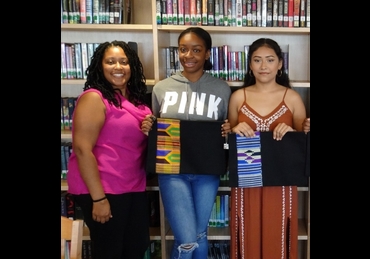
 What started as a writing contest for high school students, ended as a brilliant example of how a school can bolster the voice of students through their classroom.
ERASE Racism put out a call to action in response to the tragic events of Charlottesville, asking high school students to express their thoughts through written word or digital media. Elmont Memorial High School sent in over 40 responses to our question: How can we love each other better in our schools and communities? What does this look like? How, do you ask, did a school get 40 students to respond to this question? Simple: they brought the question directly into the classroom.
Adam Davison, the chairperson of the English Department and library at Elmont Memorial, stated that when our flyer came across Principal Kevin Dougherty's desk, Mr. Dougherty requested that he try to do something with our contest. Their English department went above our own expectations and molded the contest into an assignment for their classrooms, giving a chance for students to raise their voice on a sensitive topic all the while relating back to their classroom lessons.
Having conversations about race, culture, class, gender, power, and privilege are often seen as uncomfortable and therefore not included, often enough, in classroom discussions. However, the discomfort factor is not an excuse to refrain from discussing these topics, especially when they relate to the daily experiences of students. Being comfortable with the uncomfortable is a skill acquired through practice.Two of the students who won the contest expressed similar sentiments, not just on the lack of these conversations in the classroom, but why we should have more assignments and discussions related to these topics:
"I feel like in a classroom we should have people that either are educated or want to get educated on these issues and then present them to their fellow peers so that more people get educated and learn about these issues. Also on a larger scale we could have assemblies and things like that, that allow for the whole school to get educated or want to be interested in these issues." - Vanessa Rodriguez, Gr. 10
" Teachers [in general] do not talk about certain things, things they would find sensitive. We are not going to sit in class and have a discussion about race we are not going to have a discussion about politics or religious views but I feel like these are things we should talk about because school is where we spend most of our time, so if we are not talking about it here, where else are we really talking about it? Everyone has a different opinion, and that is not something we should be afraid of. We should be open to hearing everyone's opinion and coming to an understanding of why you agree with this or tell that person why you don't agree...so I think in school we should be able to talk about these things. "- Lauryn Alexa-Mitchell, Gr. 12
School's not only should talk about these 'things' they need to talk about these 'things.' Elmont Memorial sets a great example of how a sensitive subject can, with minimum effort, be threaded into a lesson plan.
Davison spoke about the relativeness such an assignment had to the curricula most were teaching at the time. Students were reading and analyzing a book entitled "The Book Thief," whose thematic elements called for a discussion about unjust laws and relationship between justice and perspective. The curriculum does not need to be disturbed to have these conversations. In fact, when reading through entries, many students writing reflected on what they were learning not only in their English classrooms but also in other subjects. Contest winner, Jahnia Cunningham, elaborated on the creative process of her poem stating:
"When I was doing the empowerment project in 7th and 8th grade, I thought the best way for me to express myself was through poetry and writing short stories. So this time I decided to write a poem and... it's called The Everlasting Crusade and crusades we have been studying in history, so I was basically doing our social studies homework while I was writing the poem."
At the end of the day, this contest gave students a voice on a matter that is important to talk about to combat hateful and prejudicial rhetoric such as that which fuels white supremacy and white nationalists thinking. More importantly, giving a stage for the student voice empowers and grows confidence of those whose input is sometimes discounted by adults. This was proven by 8th grader Cece Jean who stated,
"I felt like it was better for me to make a video because I felt more comfortable with it and I really enjoyed making it because I could choose my own words. And when I put it together, I was really proud of myself because I felt, you know, my opinion about all these different things that are happening really got out".
These are the breakthroughs we work for. Creating confident, educated, and courageous student leaders are a part of our mission. As English teacher Ms. Harley so eloquently affirms, "I think in life people assume that kids are not paying as much attention. That they can walk by a room and that they are not being observant. Just because they are looking at a phone doesn't mean they are not very aware of what is going on in the news and the world."
We look forward to working with more students in the future and greatly appreciate the administration and teachers at Elmont Memorial High School who worked to make this possible. Check out the students work here.