August 9, 2014
The Death of Michael Brown
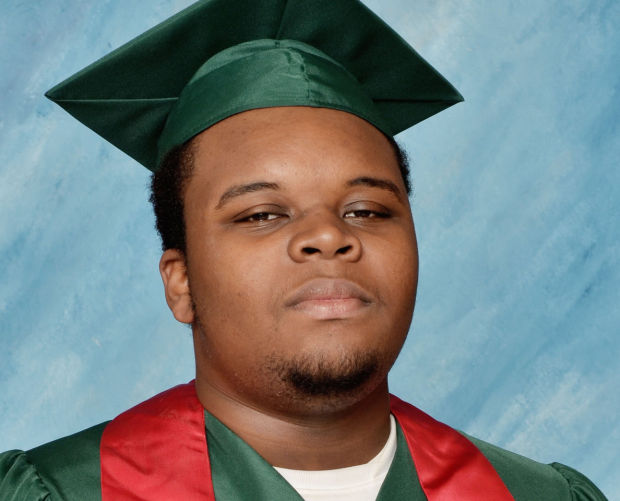 Unarmed, 18-year-old, African-American Michael Brown was shot and killed by Ferguson, Missouri police officer Darren Wilson, who fired a total of 12 bullets. Brown's body was left he street for hours. In his testimony, Wilson, who is the same height as Brown, said he felt like "a 5-year-old" in comparison to "Hulk Hogan" Brown. He also described the teenager as a "demon" and "capable of running through bullets." Wilson was not indicted. Unarmed, 18-year-old, African-American Michael Brown was shot and killed by Ferguson, Missouri police officer Darren Wilson, who fired a total of 12 bullets. Brown's body was left he street for hours. In his testimony, Wilson, who is the same height as Brown, said he felt like "a 5-year-old" in comparison to "Hulk Hogan" Brown. He also described the teenager as a "demon" and "capable of running through bullets." Wilson was not indicted.
HOW DOES THIS CONNECT TO STRUCTURAL RACISM?:
The cultural representations that helped paint Michael Brown as a monster are an expression of the history of dehumanizing blacks in the US.
For more on the death of Michael Brown, see, " Why Was Michael Brown Shot ? "
June 4, 2011
The Hate Crime of Cece McDonald
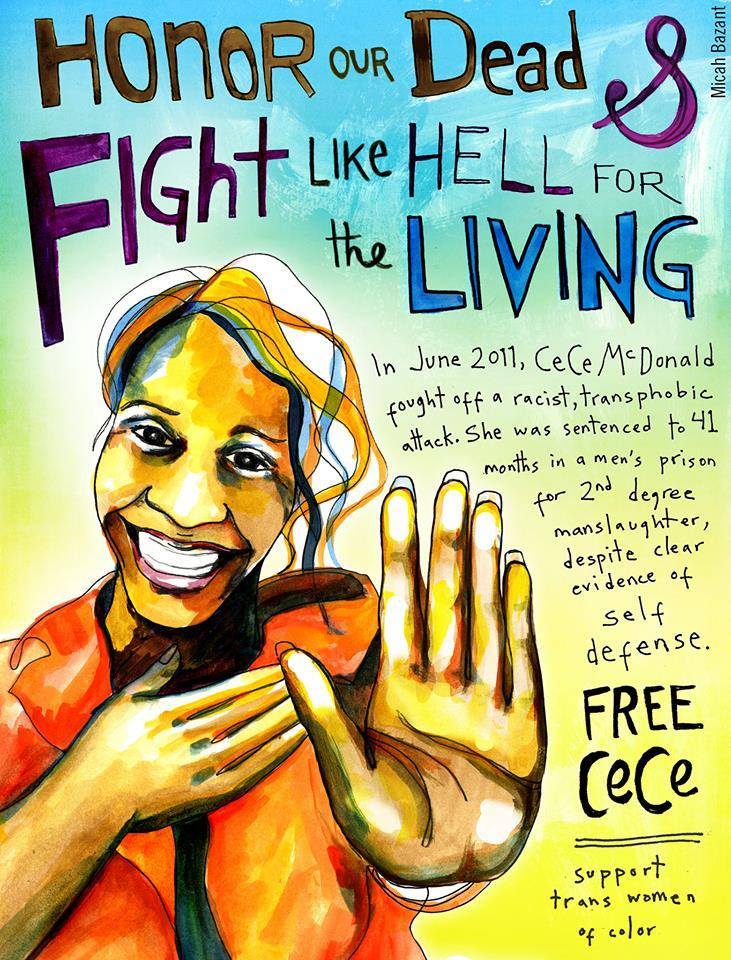
CeCe McDonald, an African American transwoman and LGBTQ activist from Minneapolis, came to media attention when she accepted a plea bargain of 41 months for second-degree manslaughter against a man who had harassed her with transphobic and racist comments. The man and his girlfriend had attacked and brutally beaten Ms. McDonald, and his death days later resulted from a wound that was inflicted during the attack. Ms. McDonalds was placed in a men's prison and served 19 months. This event is representative of the intensely disproportional amount violence inflicted on trans women of color.
HOW DOES THIS CONNECT TO STRUCTURAL RACISM?:
Despite being the victim of the attack, McDonald was criminalized for self-defense, which would have been highly unlikely if she were a white women.
For more on Cece McDonald's case, see "The Case of CeCe McDonald: Murder or Self-Defense Against a Hate Crime? "
June 17, 2015
Charleston Church Massacre
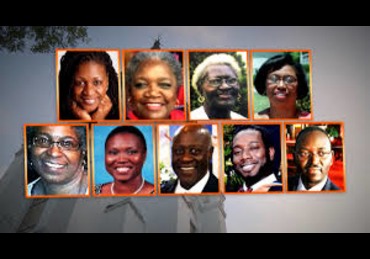
A mass shooting took place inside the historic Emanuel African Methodist Episcopal Church when 21-year-old Dylann Roof set out to harm African Americans. He murdered nine people, including State Senator Clementa C. Pickney. Despite Roof's own testimony that this was a calculated racial hate crime, many media sources attributed the cause to "mental illness". Additionally, a number of nationally known politicians downplayed the racist motives that fueled the attack.
HOW DOES THIS CONNECT TO STRUCTURAL RACISM?:
This horrendous massacre reminded many people of the 1963 bombing of the 16th Street Baptist Church in Birmingham, in which four black girls were killed. After reviewing Roof's manifesto, sociologist Dr. R. L'Heureux Lewis-McCoy pointed out that the killer subscribed to beliefs about the superiority of whites and the "natural" order of the races. Despite the decades since the 1963 bombing, the violent dehumanization of blacks still continues.
For more information see," Racism is Not a Mental Illness ".
March 18, 2015
Brutality of Martese Johnson
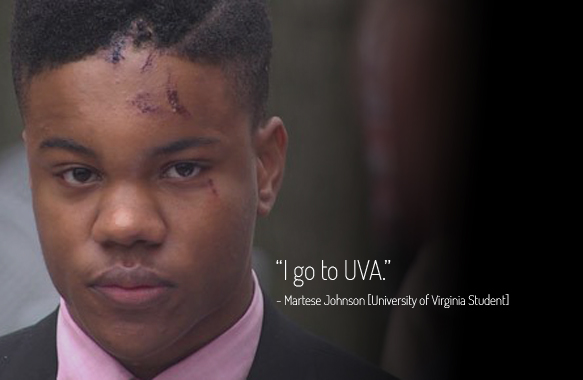
During a night out with fellow students, African American UVA student Martese Johnson was accused of having a fake ID by Virginia Alcoholic Beverage Control officers. The event, recorded by a bystander, captured the officers' excessive force as they forced his face into the cement--an injury that later required 10 stitches. Only later did officers realize that his ID was in fact legitimate.
HOW DOES THIS CONNECT TO STRUCTURAL RACISM?:
Johnson, a member of the Honor Committee, had this to say following the incident: "It does not matter if we had a previous misdemeanor charge, or if we smoked marijuana, or if we had a bad academic career. I did none of those things and still fell victim to the same treatment that young black men before me experienced, whose situations were justified by their 'bad' behavior."
For more see, " When Police Misconduct Transcends Class " .
March 7, 2015
University of Oklahoma's Sigma Alpha Epsilon Chant
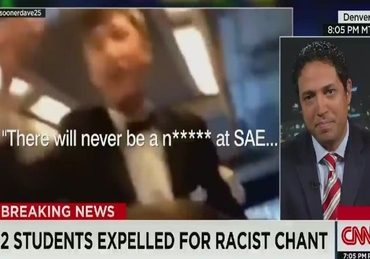 During a night out with fellow students, African American UVA student Martese Johnson was accused of having a fake ID by Virginia Alcoholic Beverage Control officers. The event, recorded by a bystander, captured the officers' excessive force as they forced his face into the cement--an injury that later required 10 stitches. Only later did officers realize that his ID was in fact legitimate. During a night out with fellow students, African American UVA student Martese Johnson was accused of having a fake ID by Virginia Alcoholic Beverage Control officers. The event, recorded by a bystander, captured the officers' excessive force as they forced his face into the cement--an injury that later required 10 stitches. Only later did officers realize that his ID was in fact legitimate.
HOW DOES THIS CONNECT TO STRUCTURAL RACISM?:
Johnson, a member of the Honor Committee, had this to say following the incident: "It does not matter if we had a previous misdemeanor charge, or if we smoked marijuana, or if we had a bad academic career. I did none of those things and still fell victim to the same treatment that young black men before me experienced, whose situations were justified by their 'bad' behavior."
For more see, " SAE Fraternity Suspended for Racist and Anti-Semitic Slurs ".
November 22, 2014
The Death of Tamir Rice
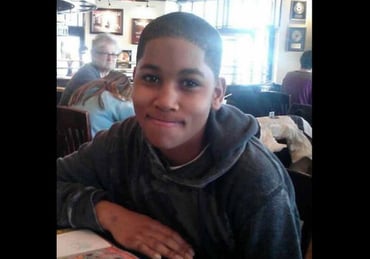
In Cleveland, Ohio, 12-year-old, African-American, Tamir Rice was playing with a toy BB gun at a local park when police fired at him twice just two seconds after arriving at the scene. Neither officer administered first aid and Tamir passed away from the gunshot wounds the next day. Many people in the media blamed Tamir's "threatening" toy as the reason for his shooting.
HOW DOES THIS CONNECT TO STRUCTURAL RACISM?:
Historically people of color have been denied the same rights as whites and have been forced to live in high poverty neighborhoods with little opportunity for economic success. The fact that some people have turned to gangs to survive has lead to a myth of blacks as being dangerous or prone to violence. The police clearly acted out on this dangerous myth.
For more see, " Tamir Rice Shooting " .
June 8, 2015
Texas Pool Party Violence
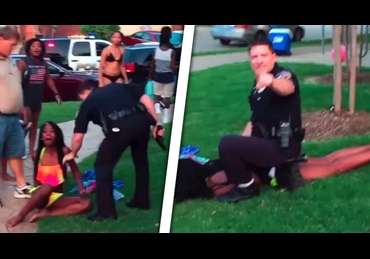
At a Texas public swimming pool, a physical altercation began when a white patron made racial comments about a young black woman, telling her to return to her "Section 8 housing" and eventually slapping her in the face. When police arrived (in the midst of confusion), numerous black teenage poolgoers were soon forced to the ground and a police officer drew his handgun. The officer later resigned when a video surfaced of him unnecessarily restraining a 15-year-old black girl in a bathing suit by forcing her into the ground.
HOW DOES THIS CONNECT TO STRUCTURAL RACISM?:
As evident in the video of this event, the police officer singled out African American teenagers, and used excessive force. This is expressive of a history of police policies that have disproportionately targeted and criminalized African Americans.
For more see, " Texas Pool Party Chaos " .
July 7, 2010
Sharron Angle
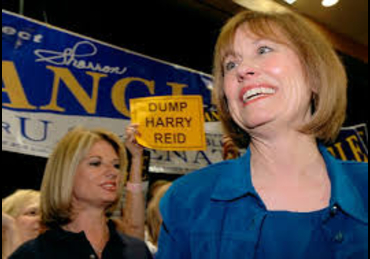 Endorsing what many called "the most racist ads of the year," U.S. Senate nominee Sharron Angle was quickly condemned by many Hispanic politicians. The ads featured "illegal aliens" as violent Mexican gangmembers. In attempt to mend her reputation as more minority-friendly, Angle spoke to a large group of Hispanic youth, where she said "I don't know that all of you are Latino. Some of you look a little more Asian to me." Endorsing what many called "the most racist ads of the year," U.S. Senate nominee Sharron Angle was quickly condemned by many Hispanic politicians. The ads featured "illegal aliens" as violent Mexican gangmembers. In attempt to mend her reputation as more minority-friendly, Angle spoke to a large group of Hispanic youth, where she said "I don't know that all of you are Latino. Some of you look a little more Asian to me."
HOW DOES THIS CONNECT TO STRUCTURAL RACISM?:
Politicians often use fear tactics to win support; however, in doing so they also reinforce dangerous racial stereotypes.
For more see, " Sharron Angle Tells Latino Kids They 'Look Asian ".
May 14, 2018
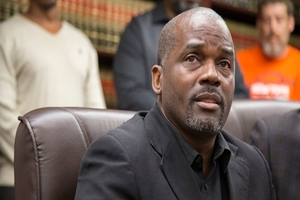 In 2016, Ronald Lanier, a retired black Nassau County correction officer, was assaulted by two white Garden City police officers, George Byrd and John Russell, who mistakenly took him for a black man who had allegedly shoplifted a purse from a village store. Lanier was shopping in a supermarket in Garden City Village—the village is 91% non-Hispanic White—when the two officers ordered him to put his hands behind his back and threw him to the ground. Lanier said they whispered in his ear, “You want to be a tough guy?” and then beat him on both sides of his ribs. He said that he complied with their orders and said, “I am on the job” — a phrase that law enforcement officers use to identify themselves to each other—and questioned why he was being detained, saying he had done nothing wrong. In 2016, Ronald Lanier, a retired black Nassau County correction officer, was assaulted by two white Garden City police officers, George Byrd and John Russell, who mistakenly took him for a black man who had allegedly shoplifted a purse from a village store. Lanier was shopping in a supermarket in Garden City Village—the village is 91% non-Hispanic White—when the two officers ordered him to put his hands behind his back and threw him to the ground. Lanier said they whispered in his ear, “You want to be a tough guy?” and then beat him on both sides of his ribs. He said that he complied with their orders and said, “I am on the job” — a phrase that law enforcement officers use to identify themselves to each other—and questioned why he was being detained, saying he had done nothing wrong.
The lawsuit claimed Ronald Lanier was assaulted both verbally and physically by police and sought at least $40 million in damages. The case recently resulted in a settlement that ordered the Village of Garden City and its police department to pay Lanier $150,000.
For more on this topic see “Papers: Garden City to pay man who alleged racial profiling”
 Share this page:
May 14, 2018
Garden City to Pay Man Who Alleged Racial Profiling
In 2016, Ronald Lanier, a retired black Nassau County correction officer, was allegedly assaulted by two white Garden City police officers, George Byrd and John Russell, who mistakenly took him for a black man who had allegedly shoplifted a purse from a village store. Lanier was shopping in a supermarket in Garden City Village—the village is 91% non-Hispanic White—when the two officers ordered him to put his hands behind his back, and threw him to the ground. Lanier claimed that the officers whispered in his ear, “You want to be a tough guy?” and then beat him on both sides of his ribs. He said that he complied with their orders and said, “I am on the job” — a phrase that law enforcement officers use to identify themselves to each other—and questioned why he was being detained, saying he had done nothing wrong.
The lawsuit claimed Ronald Lanier was assaulted both verbally and physically by police and sought at least $40 million in damages. The case recently resulted in a settlement that ordered the Village of Garden City and its police department to pay Lanier $150,000.
HOW DOES THIS CONNECT TO STRUCTURAL RACISM?
Many majority white neighborhoods on Long Island, such as Garden City, were originally populated through racial covenants and overt forms of housing discrimination that denied access to people of color. Today more subtle forms of housing discrimination persist and result in discrimination against non-whites. Since racially segregated neighborhoods create an unspoken understanding of who belongs and who does not belong, people of color are more likely to be treated with suspicion in majority white spaces.
Today Garden City Village is 0.1% black. This type of stark segregation most likely led the police officers to automatically assume that Lanier was the black suspect that they were searching for. This is why they did not bother to question him upon their arrival and instead resorted directly to force. Even when Lanier used a phrase to identify himself as a fellow police officer he was still treated as the suspect.
To read Dazio’s full article in Newsday see, “Papers: Garden City to pay man who alleged racial profiling”
|
|